
RewardExpert - Blog

RewardExpert.com is an independent website that is supported by advertising. RewardExpert.com may be compensated by credit card issuers whose offers appear on the site. Because we are paid by our advertising partners it may impact placement of products on the site, including the order in which they appear. Not all available credit card issuers or card offers are included on the site.

US Airlines Use Their Loyalty Programs To Stay Aloft

In this post:
  • US airlines would lose money without their loyalty programs.
  • The revenue from loyalty programs helps carriers to keep their business going.
  • Co-branded credit cards and travel credit cards make a lot of money for carriers and issuers.

The airline industry is ever evolving in the United States. Things have changed massively since the time when the first commercial flight was flown. Costs have increased, consumer trends have evolved, and loyalty programs have become much more than a way of earning and redeeming points.
We are also seeing a divide in the industry – some airlines are as profitable as ever, while others can no longer compete. One of the recent examples is Spirit Airlines, the pioneering discount airline, which ceased all operations and went out of business because of financial problems.
But why do some airlines stay profitable and others struggle to stay aloft? That’s because the profitable airlines are not actually making their money from selling tickets. Instead, they are earning their profits from their loyalty programs.
In recent years, frequent-flyer programs in America have grown ever larger and more lucrative. They’ve become more profitable than airlines themselves, and, in fact, airlines would lose a lot of money without loyalty programs.

There is an excellent analysis in Visual Approach Analytics that shows the state of US airline industry economics and the extent of profits that are driven by loyalty programs in comparison with airline ticket sales.
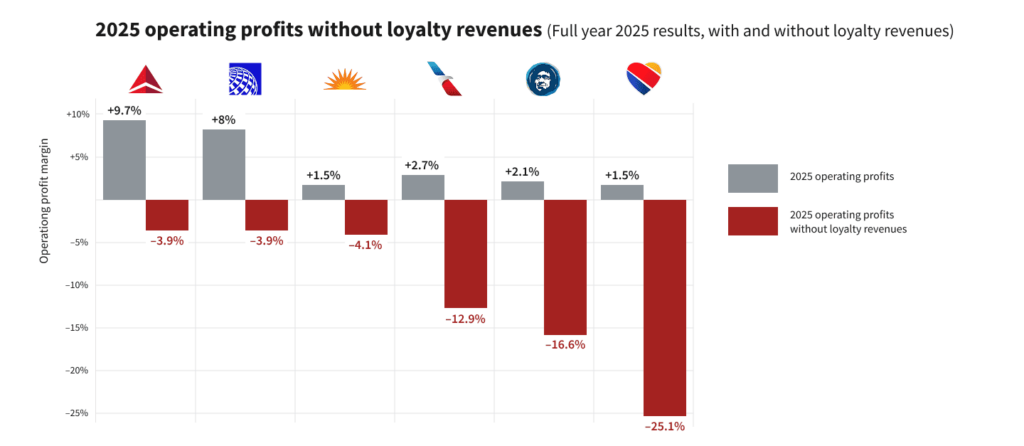
The analysis shows the 2025 operating profits of the six most profitable US airlines and compares their reported operating profits to what their operating profits would have been without loyalty revenues.
Here are the numbers at a glance:
  • Delta Air Lines had a 9.7% operating margin, but without loyalty revenue, it would’ve had a -3.9% margin
  • United Airlines had an 8% operating margin, but without loyalty revenue, it would’ve had a -3.9% margin;
  • Allegiant Air had a 1.5% operating margin, but without loyalty revenue, it would’ve had a -4.1% margin;
  • American Airlines had a 2.7% operating margin, but without loyalty revenue, it would’ve had a -12.9% margin;
  • Alaska Airlines had a 2.1% operating margin, but without loyalty revenue, it would’ve had a -16.6% margin;
  • Southwest Airlines had a 1.5% operating margin, but without loyalty revenue, it would’ve had a -25.1% margin.
How does loyalty revenue work?

The model is simple: airlines sell miles to card issuers; cardholders earn miles by spending; and those miles are eventually redeemed for travel. Each party benefits. Banks and other financial firms gain loyal customers, travelers enjoy flights and perks, and airlines secure a steady stream of profits.
If we dig more into accounting, here’s how it works:
  • When points are awarded for a flight, that gets booked as air traffic liability on the balance sheet, and then when those points are redeemed, the liability goes away, and the value of points gets booked as passenger revenue.
  • When money is spent on a co-branded credit card, the money the credit card company gives the airline is split — roughly half goes onto the balance sheet as air traffic liability, and roughly the other half gets booked as marketing revenue; when the points are used, the air traffic liability gets booked as passenger revenue.
  • When cardmembers or members of loyal programs forget about their points (or when they expire), the airline can release the liability in a breakage process, and removing the liability results in revenue.

Why are airline credit card partnerships so important?

Co-branded credit cards, and then travel credit cards like Chase’s Sapphire Reserve and American Express’ Platinum cards, have become a significant source of revenue, as well as useful tools of corporate finance. Airlines sell miles to issuers to receive much-needed cash upfront to keep things running and deliver the services later. Since carriers control the redemption rules, they can steer passengers towards off-peak flights and unsold seats.
The expansion of frequent-flyer programs also resulted in a growing number of co-branded credit cards. Delta and American Express now offer seven co-branded cards. These cards earn SkyMiles for every dollar spent, and premium versions come with such travel perks as lounge access, free checked bags, and complimentary upgrades. Even non-branded credit cards, like Chase’s Sapphire or Citi’s Strata cards, can grant access to exclusive lounges and allow cardholders to convert their points into airline miles with a range of carriers.
Over the years major US airlines significantly increased the revenue they earn from selling miles to card issuers. For example, Delta and American Airlines more than doubled their revenue over the past eight years, and United has seen growth of around 70%.
Many airlines have switched from awarding loyalty status based on miles flown to awarding loyalty status based on how much customers spend. For example, with American Airlines, you can reach the top loyalty tier without ever having stepped on one of its planes. So, you can simply have an airline credit card, spend heavily on it, and earn status points.

Bottom line

Co-branded and travel credit cards were making a lot of money for financial firms too. Annual fees are one source of revenue. American Express has hiked the annual fee for its Platinum card to a whopping $895 a year, and Chase is currently charging a $795 annual fee for its upgraded Sapphire Reserve® credit card. But the real money comes from the interchange (swipe) fees collected on transactions. U.S. banks earned tens of billions in interchange fees in 2025.
The US airline industry has evolved massively in recent years, both better and worse. The loyalty programs have become a new funnel for booking tickets and generating revenue. In other words, they’ve become another currency that airlines accept.
The US airline industry transformed to the point that it cannot exist in its current form without loyalty revenue. However, for carriers, it’s not that bad because they can compete with other airlines. It’s also good for consumers, as their tickets are essentially subsidized by credit card companies.
However, for smaller airlines, it’s hard to compete with bigger players who have robust loyalty programs. The recent example of Spirit Airlines, which eventually stopped its operations, clearly shows it.

Read more

Why Transferable Points and Miles Are More Valuable Than Other Rewards

Quick summary

  • Major credit card issuers offer credit cards with transferable rewards.
  • Transferable points offer flexibility, allowing users to choose the best partner for their desired itinerary.
  • Transferable credit card rewards offer the highest value for travelers, allowing them to get better redemption options.
  • Transferable rewards do not expire while you keep your credit card account active and in good standing.

Read more

Banks That Have Their Own Airport Lounges

Once available to “VIPs” only, airport lounges are now more accessible. Getting into airport lounges can be easy, and casual travelers can enjoy lounge spaces too. Today you can get access to lounges all across the globe without paying a fortune. A wide choice of airport lounges allows you to easily find a place to rest during a long layover or just to wait for your flight far from crowds.

Read more

Guide to Travel Transfer Partners for Major Credit Card Programs

Transferable points are probably the most valuable points to earn with a credit card. They give more flexibility when you redeem them for travel: unlike airline or hotel points, which can only be used with a specific airline or hotel, transferable points can be transferred to multiple airline or hotel loyalty programs. Plus, points transfer is given in addition to other standard redemption options, including booking travel directly through the issuer without transferring points to loyalty programs.

Read more

Tips for How to Travel if You’re On a Budget

Photo by Dino Reichmuth on Unsplash
Organizing a vacation has become significantly simpler, largely due to the internet. Nowadays, securing a hotel, flight, or dinner reservation is merely a quick search on Google away. However, traveling affordably is still often challenging.

By looking a bit further, you can uncover options ranging from economical flights to budget-friendly accommodation choices. Here are ways to enjoy a budget-friendly trip without compromising the vacation experience.

Read more

How Does A Mortgage Net Branch Work?

If you’ve been in the mortgage sector for some time, you’ve developed a network of potential lenders and borrowers. You’re likely savvy enough to know numerous loan options like the back of your hand — which helps advance your career or establish your own business.

Read more

The Ultimate Guide To Lowering Your Monthly Mortgage Expenses

Managing monthly mortgage expenses

Navigating the complex world of homeownership can be both rewarding and challenging, especially when it comes to managing monthly mortgage expenses. With the ever-fluctuating economy and varying interest rates, finding ways to reduce these costs has become a priority for many homeowners.

Read more

Budget Travel: 4 Ways To Cut Costs By Using A VPN

fly
Searching the web for international flights and accommodations is thrilling — until you reach the checkout and see the final price.
Exorbitant travel costs can’t be avoided, but many people are unaware that with a simple cybersecurity tool, these costs can be greatly reduced.

Read more

How to Find Great Deals with Google Flights

Google Flights

When you want to save money on flights or travel, using services like Google Flights can help you find great deals on flights or craft the perfect itinerary. Being a part of Google Travel, Google Flights has become a powerful flights search engine. You don’t have to be a genius to use it and you are not forced to book with it either. You simply search for available options and if you find flights you like, you simply book it directly with the airline or via a third-party online travel agency.
While Google Flights is easy to use, still you could use some tips and Google Flight features to find a great deal and save money.

Read more

Airline Checked Bag Fees and How to Avoid Them

Baggage fees have been a nuisance to flyers for several years already. These days, checked baggage is almost never free and some low-cost carriers even charge for carry-on bags now. As a result, baggage fees can really add to the total cost of your flight.

Read more

Capital One Venture X Business Card Review

The Capital One Venture X Business card is the business version of the award-winning Capital One Venture X Rewards Credit Card. The Venture X Business offers great bonuses, generous rewards, and luxury perks, all these for a reasonable annual fee. If you were looking for a credit card for your small business, this card is worth closer attention.

Read more

Plaza Premium Lounge Review: Everything You Need To Know

Plaza Premium operates a network of airport lounges around the world. Lounge locations offer a quiet space to relax and freshen up, a place to work or enjoy drinks. As Plaza Premium Lounges are back to the Priority Pass and LoungeKey networks, you may want to learn more about what they are, where they are located, and how you can get in.

Read more

Why You Absolutely Should Try Solo Travel

Have you ever had a situation when you had to choose to travel alone or not travel at all because your partner or family were not able to take the same time off work, changed their plans at the last minute, or didn’t want to travel to the destination you’ve always dreamt of? Bet that was frustrating, discouraging and disillusioning. But don’t let the lack of a travel companion lock you at home and out of amazing adventures.

Read more

Make it Easy for Clients to Pay for Their Home Improvement Projects

Recent data shows that U.S. homeowners spent an estimated $567 billion on home improvements and repairs in 2022, an increase of 15% from the previous year. That number is expected to continue to grow this year. Moreover, the top priority for homeowners this year will remain home improvement projects rather than moving into another property, largely because of persistently high mortgage interest rates.

Read more

How Much Does It Take To Form And Maintain A Limited Liability Company (LLC)?

Starting a business can be an exciting adventure rife with challenges. And to cushion any potential business problems, most entrepreneurs register their business as a Limited Liability Company (LLC).

Read more

Win More Clients For Your Insurance Business With These Tips

The insurance industry is stable and secure globally, particularly in Australia. It’s well-developed and backed by fair regulations, making insurance a good deal for insurers and policyholders. And with a growing population and new aspects of life and businesses that companies can insure, insurers can expect to go through life working in a very lucrative industry.

Read more

Top 7 Ways to Raise Money Quickly During Emergencies

Emergencies can strike at any time, and it’s always a good idea to be prepared, but if you’re in the middle of a financial crisis and don’t have savings or other cushion to rely on, don’t panic. Here are seven simple money fixes that can help you get out of the pinch.

Read more

Capital One Venture X Rewards Credit Card Review

If you’ve been looking for a premium travel rewards credit card with a moderate annual fee, rejoice! Capital One has the card just like that – the Capital One Venture X Rewards Credit Card. This card can outshine premium travel cards from Chase and Amex and become your loyal travel companion.

Read more

5 Ways To Save On Corporate Travel Expenses

Travel expenses are one of the expenses businesses must prepare and include in their budget planning. For instance, there may be seminars, conferences, in-person meetings to meet new clients or close deals, site visits, or networking events and expos in another state or country.

Read more

A 5-Step Guide To Opening Your First Business Bank Account

The decision to open a business bank account is a big one. It’s one of the things that can prove that you’re a legitimate small-business owner and that your company’s finances are distinct from your money. 
There are many business bank accounts, each serving a different purpose. Ensure you put your money into the correct account type for your financial goals so you can access good spending and saving tools. Managing your money in this manner will allow you to maximize your bank’s return, minimize fees and the hassle of managing it.  

Read more